As part of undertaking the Venus stage of Tenebrous initiation last year, I developed an Imbolc Tenebrous group ritual. I’ve meant for some time to share this, thinking it’s perhaps useful for other Tenebrous practitioners to consider. Since that time of year is quickly approaching once again, this month’s post seemed a fit place for doing this. The entry that follows will unpack the rationale for developing a “Tenebrous Pagan” ritual, and what that ritual entailed.
Introduction
What is the Venus stage of Tenebrous initiation?
The Venus stage of Tenebrous initiation takes cues from the Order of Nine Angles (ONA/O9A)’s “magickal companion” concept. Full details can be found in Nine Keys of Abyssal Darkness. In brief though, within a set period of time (e.g., one year), the sorcerer must have six in-depth discussions with their spiritual partner. They must also undertake ritual magick with this person (e.g., either as an observer or participant) three times. The former’s intent is to improve one’s ability to develop and navigate deep connections with another person. The latter demands self-honesty: one claims to manipulate acausal forces, but is this evident to the other person present?
Two important things to note here are that i) Tenebrous Venus does not require a sexual partner; and ii) Tenebrous Venus does not require the partner to be a Satanist. They do have to be fully informed of what is going on and to consent to it. But they can be whatever kind of other-spiritual-path-walker, so long as they can participate in what the initiation requires in a constructive fashion.
Certain kinds of defensively-hardcore O9A types will naturally howl at this because it makes things “too easy.” I would counter, though, that demanding one partner with a sexually-compatible-fellow-Satanist is counterproductive to what I am trying to do here. Sex is not the be-all-and-end-all of being a valid, functional human being; why then exclude people who can’t find a match in that specific department? And different perspectives mean opportunities to gain additional insights. What I fundamentally want to develop in a Tenebrous sorcerer is awareness of both social and magickal interplays of energy. In such an endeavor, trust and rapport are what’s important, not sexual prowess or ideological congruity.
Meeting challenges that come with the Venus stage
Further to the above, I would argue that having a non-Satanist partner can actually make Tenebrous initiation harder. Such a person may be wonderful for insightful conversation, but leery of the ritual component. Many otherwise open-minded people have a sort of phobia toward engaging with “dark” entities.
Is this a deal-breaker for a Tenebrous Venus companion? I actually do not think so. Recall that the initiation’s goal is to heighten the magician’s awareness of energy interplays. Such a goal does require a multi-person ritual component. But I don’t think it inherently requires said ritual to involve messing with the Nekalah – or even having Satanic trappings.
Add to this the fact that locally, I have many more Pagan friends than overtly Satanist ones. Such people are often curious about my practice, but also have lines they’d prefer not to cross entity-contact-wise. Adaptation to such circumstances in order to still perform a meaningful ritual strikes me as a good skill to cultivate. And if this causes a Satanist to bristle at the idea of “not being their real self” in ritual etc.? That, to me, is all the more a sign they should do it in the name of overcoming unproductive egoism.
With that background, this post will go on to address 1) What common ground do I perceive Tenebrous Satanism having with Paganism, so as enable a shared understanding for ritual purposes? and 2) How did I develop a ritual that would be Pagan-inclusive while still fulfilling my initiation’s requirements?
The goal isn’t to restrict other aspiring sorcerers re: “you must do this exactly,” but to offer inspiration to those who may benefit from it.
Conceptualizing Tenebrous Paganism
The primary front where I see strong compatibility between Paganism and Tenebrous Satanism lies in both being this-worldly religions. The Pagan venerates deities associated with concrete earthly realities: the natural world, the tribe, and so forth. From a Tenebrous perspective, this is obviously preferable to humans worshiping otherworldly realities tied to fantasies of “escape” from existence.
Yes, insofar as we venerate entities aligned with the Abyssal Void of Darkness, we are more otherworldly than Pagans are. But insofar as we affirm that Darkness is fundamentally in love with the flesh, we want the very kind of vital engagement with the world that Paganism evinces. Paganism suggests a style of existence wherein its practitioners are at home in the world. Careful consideration of this suggests a natural alliance: Paganism and Satanism together, against all faiths that hate the flesh.
Respect for embodied existence in turn suggests respect for the Tellurian spirits whose very mode of existence evokes proximity between the acausal and causal. It has always seemed silly to me when people insist their own gods exist but no one else’s do. I accordingly find it easy to acknowledge others’ gods even if they are not gods that I myself have an established relationship with. Doubtlessly, I will “vibe” with them more if there is thematic overlap, as one witnesses in Luciferian practitioners who work with entities such as Loki or Hecate. But I do not at all believe that you are going to, say, piss off the Nekalah by contacting such beings.
Hard vs. soft polytheism
Two paths thus present themselves to the Tenebrous Satanist.
One, we can adopt the perspective of a Pagan practitioner within a temporary ritual context, and commune with entities other than our usual therein. This is suitable when working with hard polytheists. Such Pagans insist their gods are unique individuals not reducible to generalized natural forces. If one’s Venus partner is such a person (e.g., a Heathen), one thereby challenges oneself to internalize one’s partner’s worldview.
Two, we can adopt a broadly-Pagan perspective, to undertake a ritual that Pagans will feel included in. This is suitable when working with soft polytheists, i.e., the “my storm god and your storm god represent the same force under different names” -type folks. It’s also appropriate for instances where multiple kinds of Pagan will participate in a ritual together. Its attendant challenge is to overcome differences enough to achieve good energy flow and meaningful results for everyone present.
I use the term “Tenebrous Paganism” to refer to rituals crafted with the second kind of approach in mind.
It should be noted that such rituals do not posit the Nekalah being equivalent to specific Pagan entities. Yes, my book does discuss some mythological parallels. But insofar as the Nekalah are Sinistrals, they are not – or one might say, are no longer – equivalent to Tellurian spirits of nature.
Tenebrous Pagan ritual is instead based on veneration of the same kind of natural forces as soft-polytheist Pagans venerate. I articulate these forces in a generalized way that speaks to me; a Pagan at such a ritual is free to mentally parse what I’m talking about into their own terms. Whether what such magick taps into is internal or external is debatable. But I don’t think it really matters so much as the participants feel it “works”.
Designing an Imbolc Tenebrous group ritual
Tenebrous Satanists and Pagans share a conviction that the natural world is meaningful and significant. Observation of the Wheel of the Year accordingly strikes me as a place where both can celebrate together.
With this notion in mind, I developed an Imbolc Tenebrous group ritual. I undertook this ritual with a couple Pagan friends last year.
This was the first group ritual I ever conducted. It was, moreover, one where someone in addition to myself and my magickal companion was present. For initiation purposes, it’s generally preferable for the ritual component of Venus to involve just oneself and one’s companion. But I saw no harm in having one of the three ritual engagements involve additional parties. So long as there are not so many people present as to detract from it still feeling intimate, one can still learn things from it that are relevant to the Venus stage of initiation.
Accordingly, the ritual that follows is designed to have only so many participants as can comfortably fit seated around a table. Anything unclear re: terminology or progression logic can be clarified via the Seventh Key of Nine Keys of Abyssal Darkness.
Preparation and opening
Prior to beginning, I instructed those present to think of something they wished to accomplish in the coming year. They selected an aesthetically-appropriate color of chime candle and carved a key-word related to that desire into it. The ritual began with these candles unlit in front of each seated participant (including myself).
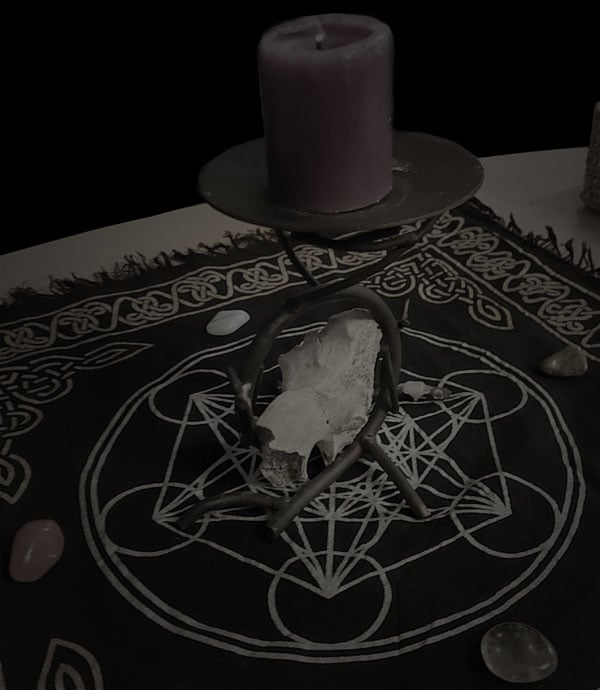
The ritual also required an altar candle, incense offering, and four crystals to represent the four elements. We used carnelian (fire), rutilated quartz (air), unakite (earth), and blue lace agate (water). Whatever stones are used, they should be large enough to be easily seen by all seated at the table.
I began by lighting the candle and proceeded:
“Eam deinceps ad aram naturae:
I hereby evoke the Tellurian spirits of fire and air, earth and water:
Come forth to witness this rite, as I, a walker of the Tenebrous path, pay tribute to the turning of the season.
Ave natura!”
Those present echoed “ave natura!” and I responded “Ga Wath Am!”
My thought here was that “the power within me is great!” is an appropriate sentiment for any and all magickal workings. Vs. “Binan Ath” (“behold the fire!”) I take as evoking what the Tenebrous Creed calls “the will of the fire”. This Abyssal element I of course include in all my own rituals, but I omitted it in the Pagan context here. One could of course include it if one’s participants consented.
Evoking the four elements
I next evoked spirits of the four elements, equivalent to the Archons / Fallen Angels / Abominations / Ancient Ones in Tenebrous ritual:
“In the south, I acknowledge the kingdom of fire, spirits of ignition and instinct:
Agios, O calor! Come forth unto this token!
In the east, I acknowledge the kingdom of air, spirits of wind and wisdom:
Agios, O aura! Come forth unto this token!
In the north, I acknowledge the kingdom of earth, spirits of soil and sustenance:
Agios, O terra! Come forth unto this token!
In the west, I acknowledge the kingdom of water, spirits of rain and renewal:
Agios, O imber! Come forth unto this token!”
With each evocation, I held up the appropriate stone, as listed in the preceding section. I would speak, and the others present would echo “Come forth!”. Then, I would place the stone on the appropriate side of the altar candle. I faced west, so fire was left, air directly in front of me, earth right, and water on the far side. (This is shown in the image at the top of this entry.) No need for any awkward “everybody stand up and turn this way!” -type nonsense this way.
This section concluded with “Ineo Naon – thus do we welcome the spirits!”
Intensification
I proceeded with the intensification thus:
“Spirits, I, Theli Lamia Othaos, pay tribute to the turning of the season:
In this time of incubation and new hopes, we come together to speak of our aspirations for the year ahead, and to plant the seeds of our success.
Bear witness to all that we do in your presence!”
The others echoed “Bear witness!”
I was the first to light my chime candle and proceed, “The seed I plant is one of [word on the candle],” followed by a brief description of the rationale for that word. I concluded with “May all willing spirits aid me!”, which was echoed by all others present before proceeding to the next person. (If preferred, could be adapted for participants to say “May [patron] aid me!” if there’s an entity they’re aligned with.) Each participant proceeded similarly in turn.
The lighting of all candles was concluded with “Thus do we pay tribute to the turning of the season!”
Closing
For the closing, I proceeded:
“Spirits, we acknowledge your power with gratitude: thank you for witnessing our deeds and for supporting our will with your own.”
I lit the incense, blew on it, and passed it onto others who did likewise. Anyone wishing to thank additional entities or forces could do so here. When the incense came back to me, I put it in the incense holder and concluded:
“Thus is the rite complete. Spirits, go forth in peace from this celebration.”
We finished with the same sequence of “Ave natura!” / “Ga Wath Am!” as in the opening, then extinguished the altar candle.
This marked the technical end of the ritual.
After a brief silence, though, we poured mead and struck up conversation about our plans for the year, which continued until the candles burned down. And my experience, both from this and similar rituals that happened later, is that such candlelight conversations have enhanced significance.
I do see the case for some kinds of ritual instead calling for silent meditative contemplation as candles burn down. But with something like the Venus stage of initiation in mind, there is value in observing: how is the energy of a conversation that takes place in the shadow of the sacred different from an ordinary conversation? Such a thing is hard to put into words – and I encourage magicians to discover this for themselves for that very reason.
Concluding thoughts
I received positive feedback in the aftermath of this ritual. And all the more so when checking in later in the year re: to what extent plans were realized.
Some related points that strike me as particularly worthy of note include:
- This ritual requires participation from all present at every phase, yet is relatively undemanding re: words needing to be memorized. Arguably a good balance between wanting participants to feel included, and not demanding so much as to put people off. Also balancing between unison-repetition and individual-speaking-from-the-heart. Different groups will differ re: where the balance between these things should fall; some participants may want more, others less. One should be mindful of such preferences in accord with whatever specific people participate, though, I’m thinking.
- The method described works to evoke four elements/directions in small spaces, so long as group energy is channeled effectively. The seated format I think was also a good fit for my particular magickal companion: it’s a bit seance-like in its way, suitable for someone of steampunk inclination. Other sorcerers undertaking Venus may want to think about this kind of aesthetic consideration in relation to their own companion.
- For Venus’ purposes, there’s a certain sense in which doing any ritual is more important than what exactly you do. This is also definitely a front on which failure can be as good or better a teacher than success. I’d therefore encourage the Tenebrous sorcerer: don’t get hung up on “it must be Satanic” or “such-and-such tradition-that’s-not-mine is cringe”. Instead, make an earnest effort to just do things! You never know what you’ll learn thereby.
Anyone in the audience with thoughts or experiences to share re: Tenebrous or other group rituals? Let us know in the comments.