Ritual magick is not necessarily a topic of interest to all readers of Nine Keys of Abyssal Darkness. I reckon I now have enough readers, though, for at least some to be willing to engage in magickal experimentation. Such individuals may wonder: are there things I personally do in ritual that are not spelled out in Nine Keys? The book’s aim was to provide a framework individuals could elaborate on in accord with their needs and preferences. Insofar as I attempted to simplify down to essentials, though, I left out finer details of what exactly I do. This post will therefore document some of these details. Of course, one needn’t do things the exact way I do. But those trying my methods and getting different results from mine may find such details worth taking into consideration.
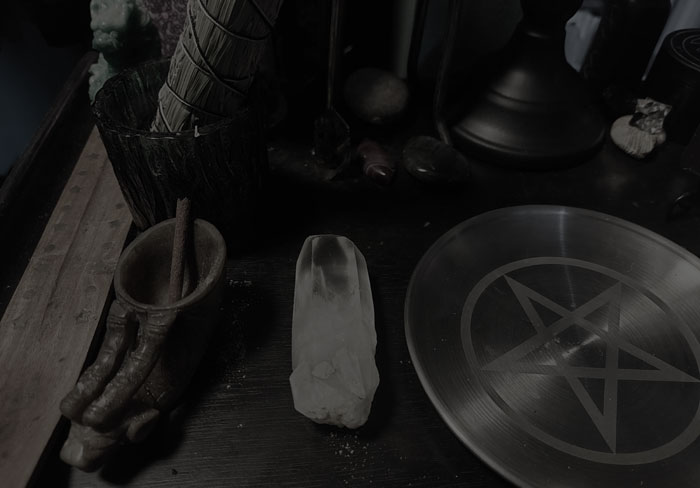
Introduction
Ritual method in Nine Keys of Abyssal Darkness is detailed, with 24 steps broken into 3 stages. For as I’ve argued elsewhere, structure is a good thing to present novices with. Vs. too-freeform kinds of magick can leave beginners confused on how to distinguish meaningful results from self-flattering delusion.
In anticipation, though, of what I describe seeming daunting, I tried to simplify when possible. For example, I thought to myself:
- “Describing exactly what I do creates extra steps many other practitioners may not really need to perform. More work to perform a ritual means lower likelihood of actually doing rituals. It’s better if people at least try doing what I’m describing. Therefore I should omit anything not 100% necessary.”
- “If I’m too specific about this, someone will read it and think they must do it that exact way. That isn’t helpful for autistic perfectionists (which the occult is full of) trying to do magick for the first time. Better to leave it vague, and let each person figure out what works for themselves.”
- “If I include this, I’m going to have to add more explanation elsewhere in order for it to fully make sense. This chapter is already too long. So let’s just gloss it over instead.”
I’ve thus omitted nothing essential from the book. And this entry is not for anyone already struggling to internalize my ritual system’s details.
But might there be someone trying my rituals and thinking “I feel on-the-right-track, but don’t know what to add to make it work better”? A glimpse into my personal practice could then be helpful. Not to encourage copying me, but in case my personalizations may help spur to their own.
My personal ritual practice
Of course, the majority of what I do in ritual does adhere to what Nine Keys of Abyssal Darkness describes. But what I’ll describe below are a few points where there are differences – small, but perhaps of import to some.
As the Seventh Key breaks Tenebrous ritual into three stages – opening, performance, and closing – this post will proceed similarly.
I assume that most readers who read this far will have my book. You should thus be able to fill in any “gaps” in this post’s account of Tenebrous ritual by consulting it.
Personal differences in how I perform ritual openings
Regarding openings, there are three noteworthy areas of difference between what the book describes and what I actually do:
Start of ritual
I have a number of pre-ritual habits that I use to demarcate ritual being an extraordinary state. Some of these precede the lighting of the candle that starts the ritual proper:
- Dress for ritual. Some rituals demand specific aesthetics, but my all-purpose go-to is a black hood and black sarong.
- Apply perfume that I only wear during rituals. Currently, this is Shalimar.
- Put on my septenary star pendant. Yes, it’s that funny-looking star that these guys wear…
- Fill a chalice with water and put it on my altar (I’ll explain what I need this for later, re: “closing”) as well as any other tools the specific ritual requires.
Once these things are done and I light the candle, there are two more “extra” things I do:
- Perform seven breaths of each of the four Contemplations described in the Fifth Key. Why does Nine Keys call for less? Because really, you should do whatever meditation puts you in a ritual-focused mindset. For some, that will be a practice from elsewhere – e.g., I almost-always also do the Falun Gong set right before I do the Tenebrous Contemplations. Others will be best-off picking just one Contemplation and doing it for the whole twenty-eight breaths. Some practitioners may even be able to shift their consciousness into the right space without meditating. Point being, it is unnecessary, and for some even counterproductive, to do exactly what I do here.
- I have a skull-shaped rattle that I shake nine times in each of the four directions. This “clearing of the air” is a holdover from LaVeyan ritual that I’ve just always done. I don’t think you “have to,” but for me, it helps me focus.
Use of incense
Nine Keys situates incense as the offering, in which case it’s not lit until the ritual’s closing. When performing rituals on my own, though, I actually use incense similarly to the candle: to indicate a ritual’s underway.
When using incense this way, I will have set the incense stick out on the altar before the ritual begins (see 4 above). When I say “Agios, O Tenebrae Profundae” is when I put down the dagger and pick up the incense. “Ave, Satanas!” is when I light it. “Veni, Malevoli!” is when I blow it out and put it in the incense holder. The incense then remains burning throughout the ritual, until whenever it burns itself out afterward.
As previously mentioned here, the specific incense I use for this has been the same for years: Satya Superhit. It’s easy to acquire, and has a distinctive scent: not unpleasant, but also not what I’d burn outside of ritual. It’s also said to be a balancer / canceller of astrological influences, which seems suitable for an astrology skeptic.
But if I use incense in this part of the ritual, how does that work for having an offering later? I’ll address this below.
Holding the crystal
There is actually a specific way that I hold my quartz crystal when I do the Evocations to the Four Directions.
It looks like this:
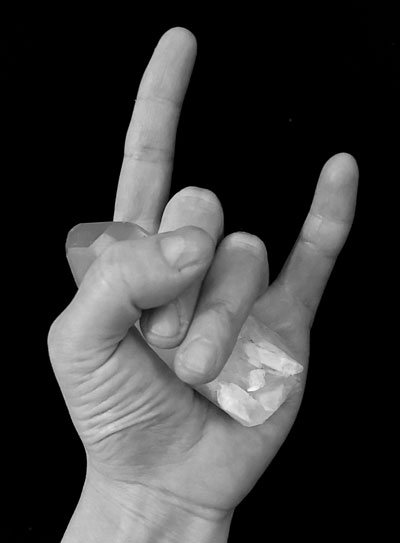
However, I thought “hold it as best you can while making The Horns, like at a metal show” sounded silly. Hence how you get the vaguer instructions that Nine Keys offers re: palm away from you, as if you’re showing the crystal to someone.
There are enough metalheads in the Satanic scene though that I really may as well just admit that this is my “actual” hold. 😉
Personal differences in the performance stage of Tenebrous ritual
Variety is inevitable here, since everything depends on the specific ritual. But the thing I’ll note applies to all rituals that use what I call multidirectional coordination. (Meaning: the performance entails doing a sequence of four things, one facing each direction. Examples in my book include the Rites of Banishing and Alignment. Vs. unidirectional coordination is when the performance consists of a single cohesive act. The Rites of Descent and the Threshold use this latter style.)
Point being, for multidirectional rituals, I always incorporate the breathing patterns of the Contemplations into my directional visualizations. I do not premeditate this before starting the ritual. Rather, the first time, I do what feels natural, and subsequently will tend to repeat that.
So for Banishing:
- Black Flame breathing (Binan Ath) for South/Fire and North/Earth. In the former case, it best stimulates a sense of “burning” within. And in the latter case, it complements the part of the visualization that involves drawing strength from the soil.
- Lunar Purification for East/Air and West/Water. Because the “drawing down from above” motion suits visualizations involving wind and rain.
And for Alignment:
- Black Flame breathing (Binan Ath) for South/Fire. Similar reasoning as with banishing.
- Lunar Purification for East/Air. Obvious choice since the visualization is suggestive of “drawing down the moon”.
- Nine-Angled Nexion (Naos) for North/Earth. One needs to connect with the Abominations in order to gaze into their mirror.
- Dagger of the Will (Ga Wath Am) for West/Water. Makes sense to accompany the call to drown doubts & delusions with the breathing style that’s most action-oriented.
Nine Keys does suggest you do this kind of thing if it helps you. For me, though, it is closer to being obligatory than to being optional.
Personal differences in how I perform ritual closings
Two things need to be addressed in this section. One is, if I’m using incense in the way I described above, how do I actually go about making offerings? The second pertains to words I speak that aren’t spelled out in the Seventh Key.
What does Othaos use for offerings in Tenebrous ritual?
My usual offering involves burning herbs. These bundles contain sage in all instances, but with these variations:
- Where purification is the working’s focus: sweetgrass + sage
- Positive-intentioned workings under a waxing moon: lavender + sage
- Negative-intentioned workings under a waning moon: mugwort + sage
(This waxing/waning distinction also applies when working with the Nekalah, as per the “factions” Nine Keys outlines.)
The chalice of water I mentioned at the start is used in connection with this bundle. If working with the Nekalah, I use a lancet to prick my finger and add a drop of blood to the water when it’s time to make the offering. But if the working is conceived as using only my own energy, not other entities’, I skip this step.
The actual offering process I then follow is:
- Light the bundle so it smolders, and then hold the bundle in the right hand, the chalice in the left.
- Facing each direction, hold the bundle over the chalice and blow the smoke over the water, nine times. (I do this as three breaths + pause, three times). This accompanies the Acknowledgments of the Four Directions my book describes.
- Still holding the chalice, raise the bundle toward each point of the compass, starting SW and going counter-clockwise. This accompanies the words described in the section below re: acknowledging the Nekalah.
- Still holding the chalice, blow over the bundle while slowly turning in a circle, three times. The first turn I dedicate to any local spirits cooperating with, or at least choosing not to hinder, my ritual. I dedicate the second turn to ancestors, and the final one to the power within me.
- Extinguish the bundle using the water in the chalice, set this on the altar, and proceed with the Parting.
Additional notes about my offering practices
The chalice serves, in all instances, as an ember-catcher. But it also provides a receptacle in which to present a blood offering if there is one. I’m not opposed to supposing that the chalice’s water represents the Abyss. My main concern, though, is practical: using it to ensure the bundle isn’t still smoldering.
It’s worth clarifying that although herbs are burned here, this is not “smudging.” There is no abalone shell and no feather; more importantly, there’s no Indigenous cultural context, nor pretentious claims to belong to such.
I do have a slightly spicy opinion about this topic. On one hand, it’s not cool to be that annoying white hippie who seems to think that loving “Indian vibes” automatically grants them access to a heritage that’s not their own. But – and this is important – if you can’t tell the difference between that Pretendian loser, and someone just taking herbs and burning them within their own clearly-non-Indigenous practice, then you’re an idiot with no business calling people out on the Internet. It’s peak Dogmagian garbage to act like cultures are set in stone and no one is “allowed” to draw inspiration by experimenting with practices and ideas originating in “the wrong” culture – and notice how this phrasing captures the far-right’s issues no less than the far-left’s!
That said, each individual magician should engage in whatever offering practice they are comfortable with. The only “rule” is “don’t do it with a shitty attitude” like you’re just trying to get rid of something. You don’t have to do exactly what I do, and my book already has enough footnotes without having to open the cultural appropriation can-of-worms. Hence why all of this isn’t something I delved into in Nine Keys of Abyssal Darkness.
How does Othaos thank the Dark Gods at the conclusion of her rituals?
One more “extra” I do in my rituals comes after “Ancient Ones, as your awakened offspring, I thank you.”
What I do at this point in the ritual is acknowledge all of the Nekalah in turn, according to the directions I experience them as manifesting from. Hence the compass-turning alluded-to in the section above.
The complete wording of this is:
- SW: Ia, Gaubni!
- S: Ia, Darkat, Abatu, Velpecula, and Davcina!
- SE: Ia, Shugara!
- E: Ia, Nemicu, Budsturga, and Sauroctonos!
- NE: Ia, Aosoth!
- N: Ia, Nythra, Athushir, Atazoth, and Shaitan!
- NW: Ia, Noctulius!
- W: Ia, Baphomet, Azanigin, and Mactoron!
This ordering of names is mostly based just on what I thought rolls off the tongue best. The one exception is that Nythra is intentionally first in that direction, to reflect this entity’s prominence in my practice.
Doing this kind of acknowledgment makes sense for me, because of how extensively I’ve built my practice around these entities. But I don’t presume that other Tenebrous Satanists will feel the same way. Maybe they primarily do “local” magick via their own energy, not “non-local” magick with entities. Or maybe they are new to the path and don’t feel a strong connection to the Nekalah yet.
In such cases, there’s no benefit to my saying “as part of doing any ritual in my system, you must also memorize this list of names”. I’d hate for that unnecessary “one more thing” to become a disincentive toward ritual performance. Furthermore, if you do want to do something like this, it needn’t necessarily be all the Nekalah, or this specific order, or organized around the directional component, etc. Hence my book’s intentionally-vague suggestion to just give whatever thanks you feel are appropriate.
A note about the Lovecraft element
Now, before I conclude, I should address the whole “Ia!” thing. This is where some readers will be like “eww, that’s from Lovecraft – how cheesy!” Having had a falling out with my Lovecraftian (now ex-)partner, I’ve debated changing it for that reason too. Ultimately though, I’ve kept it for two reasons:
- I’ve long been influenced by authors such as Kenneth Grant, Peter Carroll, Asenath Mason, and Scott Jones. So there’s never been anything “unserious” about Lovecraftian magick to me. And recently, Toby Chappell’s “Infernal Geometry” book convinced me that LaVey and Aquino took much more from Lovecraft’s work than I’d previously realized. Point being, enough people of the left-hand-path have now said “Ia!” that you can readily picture even non-Lovecraftian dark entities hearing it and knowing what you’re talking about.
- Ex aside, I remain a Lovecraft fan, as do many of my friends. At the completion of my Venus stage of initiation, I had one such close friend observe a ritual I performed. The feedback I got from this convinces me that being the black-hooded cultist calling “Ia!” in the woods does make a sublime impact on the occult-curious. It’s familiar to them via Lovecraft’s work, yet also unfamiliar re: “ooh, someone is actually doing this, really?” And that strikes me as an effect that those planning rituals that involve more than 1 person might do well to be aware of.
I share all this to make the point that if there’s some dark aesthetic element not “officially” Satanic that you think it makes intuitive sense to include in your rituals, then you not only can, but should include it. For as I said at the outset: yes, a framework helps beginners, but you have to make the ritual your own for it to be truly efficacious.
Concluding thoughts
I hope this entry gives readers an interesting deeper glimpse into my personal practice. As I said at the outset, I readily envision many practitioners getting results from my ritual system without these add-ons. Hence my my book doesn’t mention them. But I can also envision those bold enough to want to experiment finding some of this data useful. Hence why I present it here.
Has anyone in the audience attempted the meditations and rituals that Nine Keys of Abyssal Darkness describes? If so, what did you add or omit to make these practices work for you? Let me know in the comments.